

One step at a time, progress moves forward—NVIDIA emphasized this at their GDC 2026 presentation. Instead of focusing on making processors faster, we’re now looking at how AI affects visuals and overall performance. With this, frames move smoothly as environments have more defined edges. What defines power has changed; processors are no longer the sole ruler.
Imagine this: DLSS is no longer just a tool to correct fuzzy visuals. It’s a concept of sharper visuals, yes, but processors render entire visuals before what we see happens. Instead of stretching frames, we now anticipate movement, step by step. Interestingly, power consumption is no longer defined by how fast we can make it go but how smart we can make it go. Accuracy beats speed every time. Under the silent hum of processors, thoughts linger—thoughts that are wide, deliberate, and steady. Noise leads the way to progress.
Table of Contents
NVIDIA Smarter Performance Across Frames
Come mid-next week, there is something new awaiting us within NVIDIA’s beta software, something that creates a new way of building frames. Scheduled to roll out on March 31, this feature quietly fills in gaps between traditionally rendered frames. There is no stopping motion, only continuous movement, each piece aligned the moment you see it. Since nothing is stacked up all at once, movement continues smoothly. Ultimately, motion becomes smoother, much more similar to how real life actually is.
There’s a tiny shift that happens as motion unfolds. As things move, images change quickly, shifting shape according to how actions progress across various screens. What is happening next is determined by how much progress is made, where players learn by doing, not by digging through menus. The rhythm continues smoothly even if the pace is moving ahead quickly. Quiet changes take place in the background, happening exactly when needed.
There’s a game that keeps running without a hitch, even if the visuals are high-end or require sharp details. There’s a built-in sense of speed, and sharp details fit right in, sliding seamlessly into place while the game keeps running smoothly.
NVIDIA Path tracing improves the visual quality in games.
Everyone wants their games to look good, just as much as they want them to run well, and NVIDIA is always striving to improve. More intelligent modifications, courtesy of machine learning, go hand-in-hand with stronger RTX hardware, making ray tracing, something that was only a dream not too long ago, something you actually see these days in your average game. Something that was only possible, not too long ago, now runs smoothly in your average software, without any noise.
Light behaves strangely there, patterns you’ve never even noticed. Light bounces, folds, carving out shadows and illuminated zones, causing the system to misinterpret these changes as movement on the walls and floors. You notice the change as soon as something shifts. Things become deeper.. Colors take on a richer, almost lifelike quality.
But you wait, you’ll see. 007: First Light will suddenly materialize, followed closely by Control: Resonant, gliding effortlessly forward, with Tides of Annihilation plodding along behind it, each one redefining what’s possible in real-time graphics. There’s nothing here that’s content with mere tweaking, sitting on the cusp of something akin to cinematic quality, movement reminiscent of those classic reels, something you could only dream of seeing during actual gameplay until now.
NVIDIA RTX MegaGeometry creates richly detailed worlds
The funny thing is that the more detailed the picture, the more it may slow down. Yet the company continues its efforts, exploring new frontiers such as RTX MegaGeometry.
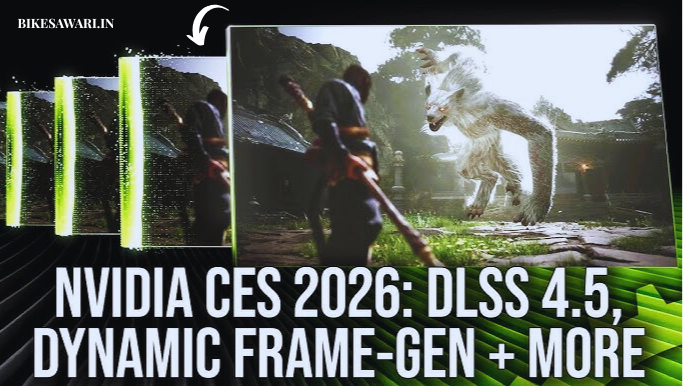
This was first seen in Alan Wake 2. There are broad spaces in the game; this makes movement easier. If the trees are clustered together, movement is slower compared to broad spaces. Light paths are used instead of heavy caches. There is room to breathe as the scene is not cluttered. The scene is always clear and the mind processes the details without getting confused.
The obstacles that once held you back, that once stood in your way, are what?Today, solutions are provided almost automatically. Today, more and more games, such as Control: Resonant, are employing this. Depth is increasing with the hands of the developers. The movement is smooth and swift. The designs are quiet and unobtrusive with steady frame rates. Some systems accomplish this level of smoothness without drawing any attention to them. In this case, the system is quiet and unobtrusive as it raises everything upwards.
A Unified Experience With the NVIDIA App
This is the feeling: the controls are right at your fingertips, so updates roll in quietly and features spring to life clean and unencumbered, all with a smooth and hitch-free operation. When the world is about to descend into chaos, the app comes in with a calm and almost ready-made confidence, as if it had been hiding in the wings all the while.
And the way it operates is so easy and effortless, even with the most challenging tasks, so that users can fine-tune the settings with ease, boosting the performance and fine-tuning the graphics without a guiding hand.
Also Read – iPhone 18 Pro Max Price Revealed! Will It Be Cheaper, or Will Apple Deliver a Major Shock?
