

First, Google decides to unveil Gemma 4 – an innovative step in open AI which is subtle yet critical. This new addition to the field comes from the laboratories of Google DeepMind. It does not feature any fanfare or major announcements yet has a huge value for developers and researchers everywhere.
Gone are fancy bells and whistles; this gives you practical prowess, allowing you to let your sophisticated technologies go from being confined to the laboratory environment into everyday use. As the system develops, one thing becomes increasingly evident; power is distributed horizontally, rather than vertically.
Amidst all the rush and competition in the realm of artificial intelligence development, Gemma 4 attracts considerable interest, not so much due to its functions, but due to its free availability courtesy of the Apache 2.0 license issued by Google.
You may take it, modify it, create products based upon it, and distribute them, without paying anything whatsoever. Through such an approach, Google makes an unequivocal statement: it is the era of transparency and open source in light of catching up to the leading companies throughout the world.
Table of Contents
A New Age of AI Availability
It is here that Gemma 4 was born. It was not created from scratch but rather based on the engine behind Google’s most powerful AI called Gemini 3. In that way, innovative thought escapes closed doors. That which was once guarded and hidden behind closed gates comes to freely enter the open space. A path opens itself where there was none before. Is this good design? Maybe, because the lock just cracked.
It is here where prohibitively high prices used to be barriers for the adoption of innovative technology. But the availability of free access shifts the dynamics significantly. Any person can experiment without breaking the bank using the open framework provided by Google. Forget costly hardware. Run experiments, develop innovations, even launch products from your living room. Better opportunities come faster. Distances vanish at the touch of a button.
Gemma 4 Unique Look Quicker Performance Improved Functions
One of Gemma 4′s standout features is how it handles tasks like an efficient worker rather than an extravagant showpiece. Models differ significantly in size, from little to big ones, but none of them has scaling issues and crowded interfaces. Contrary to the principle of one size fits all, selecting models is done naturally, driven by necessity depending on particular tasks. Designs of phones can hide the smallest structure. For instances of massive data, electricity can be generated by the biggest frame.
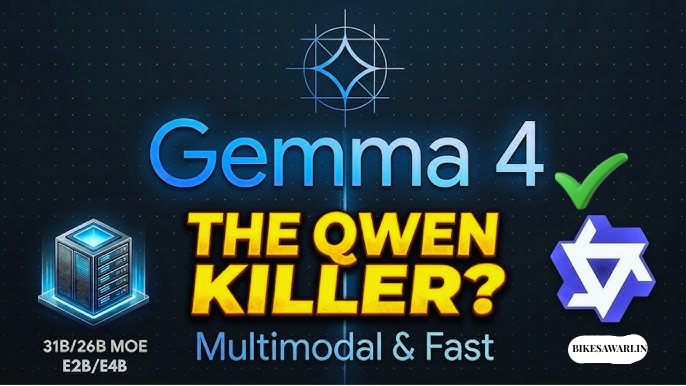
Without being connected to the internet, Gemma 4 functions in the open space independently. Models with tiny structures of 2 billion and 4 billion parameters can be included in phone, Raspberry Pi, and mini NVIDIA designs. Cloud computing for its instant response speed is not needed because of its availability all the time, whether online or offline. Local data storage avoids lagging and protects user space at the very beginning.
Sometimes, a machine with multilingual proficiency comes into sight. Gemma 4 can handle over 140 linguistic dialects; thus, it is capable of surpassing standard languages like English and Chinese. While many focus on major languages like French and Japanese, this machine focuses on minor regions where dialects seldom exist. Because of its vast language capacity, phrases transition seamlessly among groups that previously had communication barriers.
The first impression of Gemma 4 is its movement despite no physical interaction. Unlike conventional systems that respond to input, Gemma 4 relies on sequences, preparing actions ahead of time rather than reacting instantly while manipulating segments of code simultaneously. It handles speech recognition and moving videos in fragments. Individuals use this product not for chitchatting but for analyzing issues that impede their progress.
AI on mobile phones is possible now
From where it stands, the new Gemma 4 enables intelligence in the device through its internal capabilities. This innovation eliminates lag since no server communication is needed. Operations occur locally without the need to connect to the internet. Programs appear more responsive, responding even before you make up your mind about what to do next. Your phone thinks fast, just as you do.
Software applications can perform operations directly within the hardware using platforms such as AICore Developer Preview and Google’s AI Edge Gallery app. This is made possible by an innovative concept known as “Agent Skills.” Localized processes increase speed while maintaining privacy because of internal computation of operations.
The release of new devices equipped with Gemini Nano 4 may be expected in the autumn season according to Google. The phones will operate perfectly from the beginning. With phones integrating the use of Gemma 4, expectations continue to rise.
gemma 4 utilized by developers and companies
Starting afresh with Gemma 4 is surprisingly easy. To save time, software engineers will normally opt for robust models – say, 26B and 31B versions – which can be found on websites like Google AI Studio. By downloading the files of the model from sources like Hugging Face, Kaggle, or Ollama, you remain in charge of the process. The direct use of files in your personal computer makes local processing not only possible but easy. Personal preferences determine the working environment without imposing additional requirements or limitations.
Compatibility is almost immediate – software such as Hugging Face Transformers, vLLM, llama.cpp, and NVIDIA NIM is fully compatible. Regardless of whether you work in a Windows, Linux, or macOS environment, Gemma 4 easily integrates with your system. A small computer designed for mini-computers like the Raspberry Pi 5 can unobtrusively plug into robots and other concealed devices.
Emergence of competition for the AI market
Even with a high level of competition, right from its debut, Gemma 4 demonstrates its worth in the AI space. The likes of Big Techs such as Meta Llama and others are actively working to be on top. On its own, there is DeepSeek from China providing robust alternatives too.
Leading silently and without a lot of fuss is the Google approach. No reliance on massive hardware but good decision-making, as evident with the Gemma 4. Compact size aside, the AI’s high intelligence catches one’s attention immediately. It does not matter if it is an old device; Gemma 4 performs excellently.
The speed factor can catch anyone’s attention at the initial stages. What remains, though, is simplicity in design. Programmers understand the importance, especially when costs are limited. Consistent effort comes but with results gradually growing. With every passing week, power conservation reduces expenses slightly but significantly.
Also Read – Good News for Gamers! NVIDIA Reveals DLSS 4.5 Launch Date and New Path Tracing Games.
Also Read – Gaming Just Got More Expensive! Sony Hikes Prices for PS5, PS5 Pro, and Portal
