

Musicians often have to cope with a sense of anger that follows them around after their music does not sit well with others. No sooner had it come out than Nora Fatehi’s “Sarke Sarke” disappeared from YouTube due to a flurry of backlash against its lyrics. Tied in with a movie called KD: The Devil, this track sparked a firestorm of online chatter, with jokes giving way to demands for it to be taken down.
The more it got lambasted by the hour, the more it was a foregone conclusion that it would be taken down. And then, in a sudden twist, it’s back to pondering how artists must walk a line that’s easily crossed into a gray area in mainstream entertainment.
Table of Contents
Nora Fatehi A Viral Song Stirs Talk
Suddenly and all at once, the song “Sarke Chunar Teri Sarke” appeared on all the screens with a bright glow of the spotlight. Nora Fatehi appeared on the screen with an aura of radiance and smoothness. Then, sometimes, the presence of Sanjay Dutt appeared with low-key and familiar characteristics, as if the presence of the past had been brought back. His dialogue came out slowly and surely: “I am the villain.”
It felt as though the passage of time had been brought together with the present. The song had appeared with a swift attention-grabbing beat and frenzied visuals. After the song appeared, the talk had shifted. The tune had lost its grip on the public, yet the conversation had begun. On the internet, the responses had appeared in a rush. There were many readers who had read the dialogue.
Nora Fatehi Words That Triggered a Backlash
Rakib Alam’s lyrics gained traction in no time. People were forced to stop and look at the words that hadn’t been expected. The tone changed when audio and picture came together. A word that may have been innocuous in written form took an different shape when it came together with the visuals and responded accordingly. The rhythm itself was unusual, but what really got people’s attention and bothered them was the change in tone from playful to more serious.
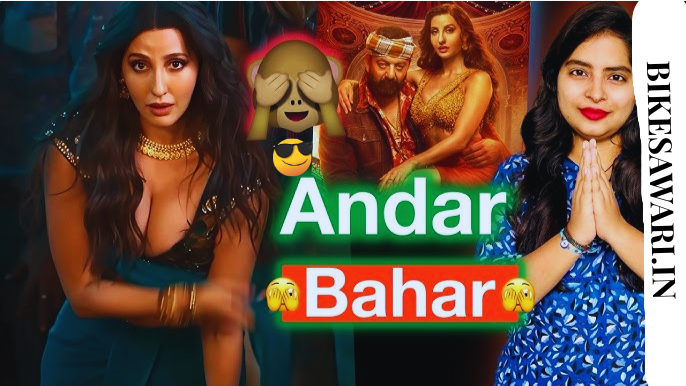
Words such as “lifting,” “putting inside,” and “not letting a drop spill” went viral in no time and sparked a lot of discussion in every corner of cyberspace. Some said it was nothing unusual for a daring Bollywood song intended to entertain, but others were more resistant to this and a large undercurrent of criticism said that the lyrics were vulgar and that there was no real point to it.
Nora Fatehi Public Outcry and Skepticism Lead to a Ban Talk
Of course, this wasn’t just a reaction from ordinary people. Celebrities also got into the mix and took a cue from the authorities’ stance. Priyank Kanoongo from NHRC got into this conversation and broke down the lyrics of this song with no room for ambiguity. He grappled with a question that bothered most homes: whether it’s really possible for a whole family to share that moment when what kids watch at home really matters a lot.
Armaan Malik’s posts were filled with frustration. Though he didn’t specify which song he was referring to, he implied that most songs currently dominating the charts were made under more relaxed guidelines and were becoming less and less original in their rise to fame. However, he ended this post with a more pleading tone, encouraging artists to be more mindful and considerate before bringing out new content.
The comments section under this video crackled with reactions. Some people praised this song’s rhythm and Nora’s vocals, but these were drowned out by more vocal opinions. Some people were criticizing this song for being crude and crossing some lines that were deemed a bit unsafe for such content. Some people went as far as saying that this song was a bit like some provocative Bhojpuri songs that sparked controversy wherever they were listened to.
Nora Fatehi Song Taken Down From YouTube
With every new news piece, there was more pressure building up against those responsible for it. While there is news that this video remained up till March 16th on YouTube, come morning of the next day, this version of the song in Hindi had simply disappeared—without a trace.
But there is no indication of what led to this decision. Most probably, there was pressure building up against those responsible from outside. Or perhaps, there was something inside, something whispered. But one thing is certain: no one knows where this pressure came from.
Nora Fatehi Where Should Limits Lie?
The question of where art should draw its line has been a topic of debate in recent times, especially when it comes to issues of public responsibility. There is a bold edge in songs that are made for entertainment purposes, and this edge still finds its way into Indian cinema, even when some people express dissenting views. In recent times, some songs have topped charts and continue to attract large crowds in spite of some people expressing dissenting views about them.

However, in recent times, there have been more comments about such issues. Incidences are being spotted more often, and when something does not seem right, the comment button is lit up in no time. However, it is said that freedom is most important when it comes to producing content such as shows. After all, it is a decision that each and every individual must take for themselves.
However, in recent times, the case of “Sarke Sarke” has shown that some old issues still exist in society in relation to this topic.
More Trouble in Music
Ironically, history is repeating itself. Recall when rapper Badshah was under severe criticism for his song “Taapsee.” The way young women in uniform were portrayed in the song and video of “Taapsee” did not go down well with everyone, resulting in a debate on the issue.
The criticism of Badshah and his song “Taapsee” gained momentum, with the issue being referred to the courts. The Child Rights Commission and Women’s Commission reportedly served notices. No sooner did this incident occur than another disturbing post, reportedly from the Lawrence Bishnoi network, began appearing online.
Industry Ripples
Today’s people interact with music, with tales, in newer, louder ways, with conflict stripping back the layers to expose how their response changes. Now, what passes them by is subject to a finer tooth comb. It’s not about being good enough; it’s about how you’re received that guides movies such as KD: The Devil, where the crowd arrives. Nora Fatehi’s entrance into the scene is not about precise dialogue, but about how much the crowd leans in.
Winning slips out of your grasp when you hold on too tight, not about how much behind-the-scenes effort you put in. Immediately following a movie’s release, the taste is more defined than any blueprint dared hope to imagine.
This idea still lingers: do you change your craft to avoid upsetting them? Or do you hope your audience becomes more comfortable with what is not like them? Sometimes, that uneasy feeling isn’t such a bad thing, after all. Perhaps there is a middle ground between the two. Striving towards perfection is not always the goal.
